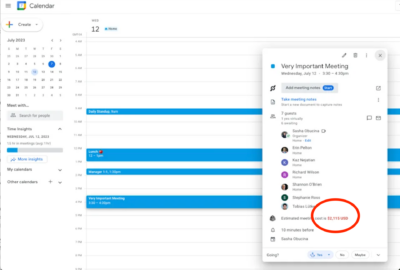
Of course, sometimes you really do need a meeting. A real-time discussion can be helpful for things like:
- complex decisions
- sensitive conversations
- collaborative problem solving
But a lot of meetings are scheduled by default, not out of necessity
Origen: Meetings are eating your margins – RescueTime Blog
Researchers estimate that companies could save at least $25,000 per employee by reducing unnecessary meeting attendance. Multiply that across a mid-sized business of 100 people, and that’s $2.5 million on the line.
The hidden cost of meetings is especially significant for knowledge workers. Writing, coding, designing, and strategic planning require sustained attention that is almost always found in long focus sessions.
Before scheduling a meeting, ask yourself one thing: What specific task can’t be accomplished asynchronously? If you need to share updates, review information, or get general feedback, you should be able to do that in chat or with a recorded video.
The most productive meetings include between five and eight attendees, so it’s time to get choosy.
It’s easy to spend your entire day bouncing between meetings, messages, and emails without making meaningful progress on your most important tasks.
Execution-first days solve that problem by intentionally limiting meetings during designated periods. (Yes, this is just another name for one of our favorite concepts, teamwide focus sessions.)
Encourage employees to block their own time for deep work and give them explicit permission to protect it. That might look like declining meetings, moving non-urgent discussions, or suggesting asynchronous alternatives.
Every meeting carries a cost. If you wouldn’t approve the cost on paper, why are you approving it in the calendar?